Next Day Delivery from £15.00
Call +44 (0)1296 431135 for Sales Advice
Email sales@coldene.com for support
Article
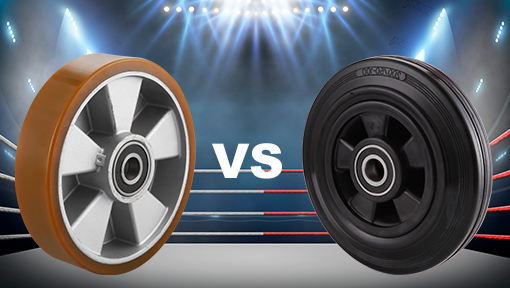
Rubber and polyurethane are the most commonly used materials for wheel and castor tyres. Despite their distinct natures, they are frequently used interchangeably, but what sets them apart? Understanding the relative advantages and disadvantages of each material is essential to determining the best wheel or tread for your specific castor or wheel application.
Polyurethane and rubber have their own unique characteristics that make them suitable for different purposes.
Rubber castors are best for outdoor or rough surfaces, providing a softer ride and better traction over harsh terrain. Polyurethane castors, on the other hand, are better suited for indoor or smooth floor surfaces. They offer superior load capacity and wear resistance. So, the type of flooring surface is a crucial factor to consider when choosing between rubber and polyurethane castors.
To make an informed decision, you should keep the following in mind:
The Elastic rubber tyres are the softest and can absorb vibrations and shock impacts. However, they are predominantly produced using a black filler that can mark floors. Grey and Blue” non-marking options” are now available and are manufactured using a material that won’t mark the floor.
Polyurethane tyres may be a more suitable option when considering floor protection. Available in many colours, polyurethane’s production process ensures there is no colour transference to the floor. A polyurethane wheel may be the best choice if the floors are expensive and/or critical to the operation.
Rolling resistance is an essential factor affecting how easily equipment is used. The lower the rolling resistance, the easier it is to manoeuvre the equipment, which ultimately reduces operator fatigue and increases its efficiency. To reduce rolling resistance, it’s important to focus on the consistency and hardness of the material the equipment is made of.
Polyurethane tyres have a synthetic structure that provides greater consistency than natural rubber. This results in consistent levels of rolling friction, leading to lower rolling resistance. Polyurethane castors are typically made in harder compounds than rubber, making them easier to manoeuvre due to their lower rolling resistance.
It’s important to consider a castor wheel’s cushioning and resilience factor when looking for a comfortable and smooth ride. The stiffness of the wheel determines the cushioning levels. Softer materials tend to deform more, absorb shocks better and provide a smoother ride. Rubber castors are usually softer than polyurethane castors, providing better cushioning.
However, it’s worth noting that higher cushioning also means higher roll resistance. This may affect the manoeuvrability of the wheel. Therefore, deciding which is more important for your application – smoothness or manoeuvrability – is essential before choosing the best material.
Rubber castors provide a smoother ride but are less durable than polyurethane. Over time, the rubber castors will perish faster than polyurethane which tend to have much higher resistance to wear and abrasion. In controlled tests, polyurethane castor wheels have lasted up to three times longer than rubber castor wheels. Depending on the formulation, polyurethane castors also tend to outperform rubber in resisting oil, grease, and chemicals.
With decades of experience, our specialists are experts in advising and specifying top-quality wheel and castor solutions. Don’t hesitate to reach out and speak to an advisor today.
If you have a question around a product, or just a general query. Call us on 01296 431135, or submit the form below.

Receive 10% off of your first order with Coldene, use code WELCOME10